
New Revised NERDC Primary 4 Pre-Vocational Studies Scheme of Work
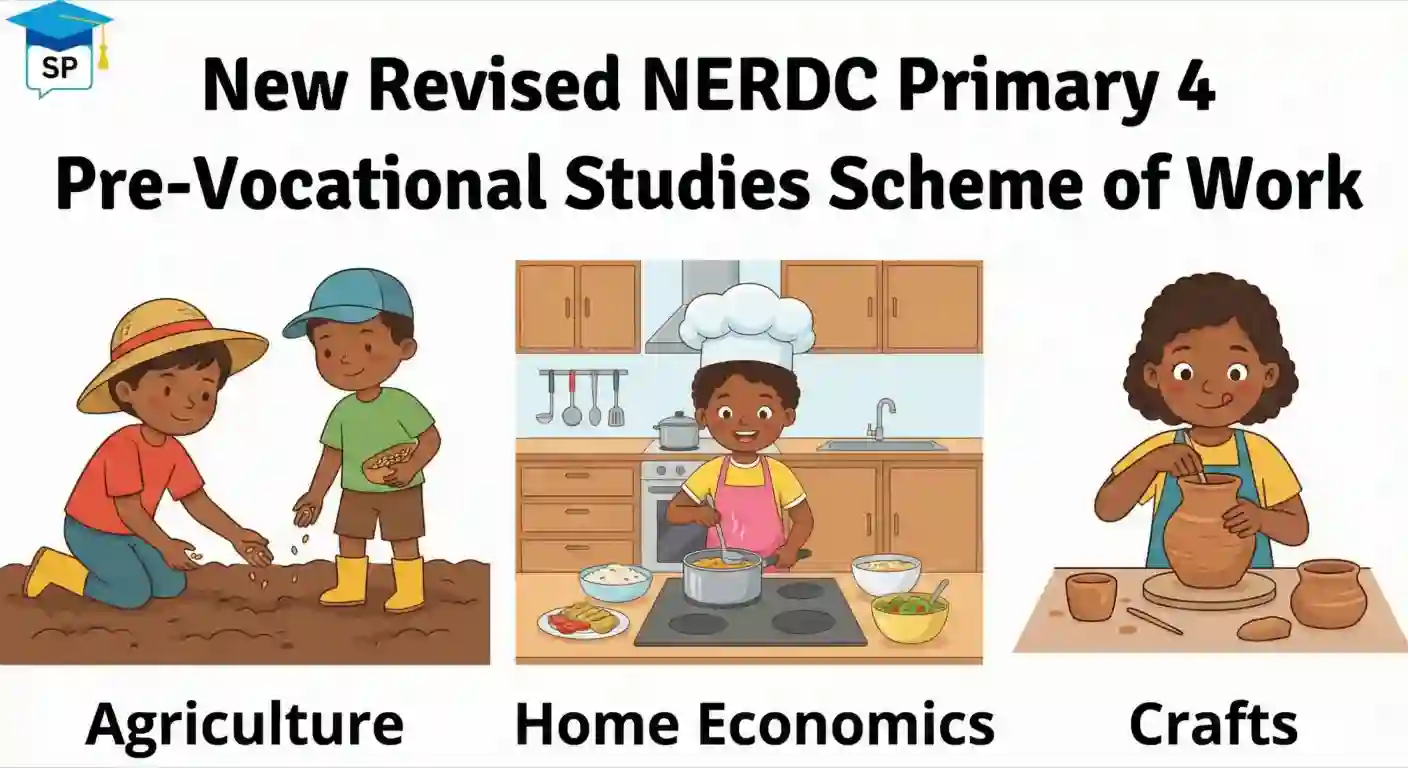
Week 1: Meaning of Agriculture
1. Content: Meaning of Agriculture: growing of crops like corn, rice, guinea corn, cassava; rearing of animals like chicken, pig, goat, cattle.
2. Performance Objectives: Define agriculture, identify basic agricultural activities.
3. Learning Activities:
i. Teacher Activities: The teacher displays live samples in class, the teacher explains the meaning of agriculture, the teacher guides pupils to mention activities that build up the definition.
ii. Learning Activities: The learners suggest definition of agriculture, the learners identify the various crops displayed.
4. Teaching and Learning Resources: Pictorial display of people planting crops and rearing animals. Use live samples of crop produce like corn, rice, cassava, or yam to make the lesson tangible. These materials help pupils connect the definition of agriculture to real items they see in their environment.
Week 2: Meaning of Agriculture
1. Content: Processing and selling of agricultural products; importance of agriculture: as source of food, income generation, job or employment, producing industrial raw materials, cloth making, medicines etc.; people in agriculture: animal rearers, crop farmers, fishermen, market people, gardeners, agriculture teachers.
2. Performance Objectives: List the importance of agriculture in Nigeria, identify people involved in agricultural activities.
3. Learning Activities:
i. Teacher Activities: The teacher guides pupils to mention the importance of agriculture in Nigeria and explains briefly each, the teacher asks pupils to name different activities that people engaged in agriculture do, the teacher explains the role performed by each group, the teacher gives a board summary.
ii. Learning Activities: The learners mention what they know as the importance of agriculture to the community, the learners list the different activities that people engaged in agriculture do in their localities, the learners copy board summary.
4. Teaching and Learning Resources: Simple chart or pictures showing the importance of agriculture in Nigeria. Include pictorial displays of people processing and selling agricultural products like farmers harvesting crops, market traders selling produce, and people making products from agricultural materials.
Week 3: Soil Types and Enrichment
1. Content: Meaning of soil; soil classification: clay, sandy and loamy.
2. Performance Objectives: Define soil, list soil types.
3. Learning Activities:
i. Teacher Activities: The teacher collects soil samples to show their characteristics, the teacher performs simple soil experiments to show their properties.
ii. Learning Activities: The learners observe and identify soil types, the learners collect different soil types and note their differences.
4. Teaching and Learning Resources: Soil samples: sandy, clayey and loamy soils collected from different locations. Use a funnel, water, measuring glass, filter paper, and cotton wool for conducting simple experiments that demonstrate soil properties like water retention and drainage.
Week 4: Soil Types and Enrichment
1. Content: Causes of soil fertility reduction: burning, leaching, overgrazing, clean clearing, erosion, etc.
2. Performance Objectives: Mention the causes of soil fertility reduction.
3. Learning Activities:
i. Teacher Activities: The teacher guides soil fertility discussions, the teacher collects samples of fertile soil (loam) and non-fertile soil (sand) in separate pots.
ii. Learning Activities: The learners participate in class discussions, the learners participate in carrying out the experiments set up by the teacher.
4. Teaching and Learning Resources: Pots for planting experiments and maize grains for demonstrating growth in different soil types. Use soil samples that clearly show differences between fertile loam and less fertile sandy soil to help pupils understand fertility concepts visually.
Week 5: Soil Types and Enrichment
1. Content: Ways of making the soil fertile: adding fertilizer, manuring, mulching, crop rotation, leaving fallow; maintain soil fertility.
2. Performance Objectives: Describe ways of enriching soil fertility, maintain the soil fertility of the school farm.
3. Learning Activities:
i. Teacher Activities: The teacher plants maize in the pots to illustrate effect of soil fertility level on the plants, the teacher gives a board summary.
ii. Learning Activities: The learners participate in carrying out the experiments, the learners copy board summary.
4. Teaching and Learning Resources: Pots, maize grains, and different soil samples for practical demonstrations. Use fertilizer samples or compost to show pupils what enrichment materials look like and how they improve soil quality when properly applied.
Week 6: Agricultural Tools and Equipment
1. Content: Farm tools: cutting tools e.g. cutlass, sickle, axe, etc.; digging tools e.g. hoe, pick axe, spade, etc.
2. Performance Objectives: Name farm tools, identify and describe the tools and their uses.
3. Learning Activities:
i. Teacher Activities: The teacher displays the tools in class, the teacher helps pupils to identify farm tools and their uses.
ii. Learning Activities: The learners identify and narrate the uses of farm tools.
4. Teaching and Learning Resources: Different farm tools including hoe, cutlass, spade, shovel, rake, and pick axe. Display posters, charts, and pictures of farm tools in use to help pupils who cannot handle actual tools still understand their functions and applications.
Week 7: Mid-Term Break
The mid-term break provides rest for pupils and teachers. Teachers should conduct a mid-term test covering topics from Week 1 to Week 6 before the break. This assessment helps identify areas where pupils need additional support when classes resume.
Week 8: Agricultural Tools and Equipment
1. Content: Carrying tools e.g. basket, head pan, wheel barrow, etc.; gathering tools e.g. rake.
2. Performance Objectives: Identify and describe the tools and their uses.
3. Learning Activities:
i. Teacher Activities: The teacher demonstrates the use of farm tools.
ii. Learning Activities: The learners use some farm tools on the school farm.
4. Teaching and Learning Resources: Wheelbarrow, baskets for carrying farm produce, and charts showing farm tools in use. These materials help pupils understand how farmers transport crops and gather harvested materials efficiently during farming activities.
Week 9: Agricultural Tools and Equipment
1. Content: Animal farm tools: fishing nets, traps, hook and line, baskets, watering troughs, feeding troughs, etc.
2. Performance Objectives: Identify and describe the tools and their uses.
3. Learning Activities:
i. Teacher Activities: The teacher displays the tools in class, the teacher demonstrates the use of farm tools.
ii. Learning Activities: The learners identify and narrate the uses of farm tools, the learners use some farm tools on the school farm.
4. Teaching and Learning Resources: Fishing nets, hook and line, watering troughs, and feeding troughs. Include pictures of animal farm tools to supplement actual tools and help pupils understand how these equipment support animal rearing activities.
Week 10: Agricultural Tools and Equipment
1. Content: Maintenance and care of the tools: store in a cool dry place, wash/clean and dry, rub oil on metal ends to avoid rusting, sharpening blunt edges, etc.
2. Performance Objectives: Maintain the tools after use.
3. Learning Activities:
i. Teacher Activities: The teacher demonstrates proper maintenance of farm tools, the teacher gives a board summary.
ii. Learning Activities: The learners carry out proper maintenance of tools after use, the learners copy board summary.
4. Teaching and Learning Resources: Farm tools for demonstration, oil for treating metal parts, and cleaning materials like rags and water. These resources enable pupils to practice proper tool maintenance that extends the lifespan of farming equipment.
Week 11: Revision
Revision week allows teachers to review all topics covered from Week 1 to Week 10. Go through key concepts, clarify difficult areas, and prepare pupils for the examination. Use questions, discussions, and brief practical demonstrations to reinforce learning.
Week 12: Examination
The examination week tests pupils on all first term topics. Set questions that cover agriculture definitions, soil types, farm tools identification, and maintenance procedures. Include both theoretical questions and practical identification tasks to assess complete understanding.
Week 13: Examination, Marking & Vacation
Complete the examination process, mark all papers, and record scores in the appropriate registers. Provide feedback to pupils on their performance and areas for improvement. Once marking and recording are finished, the term vacation begins.