
2026 JAMB Subject Combination for Applied Biochemistry
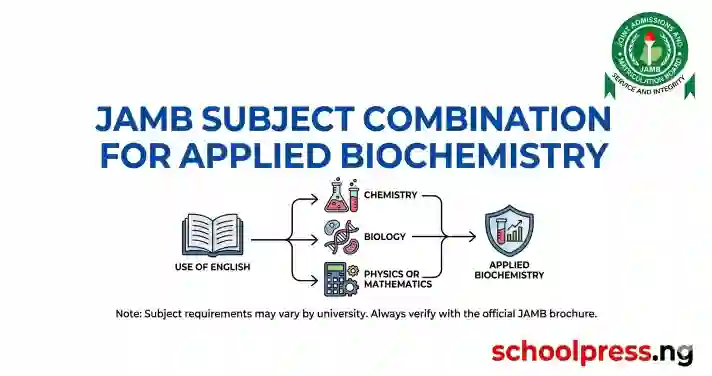
JAMB subject combination for Applied Biochemistry is a critical requirement for students seeking admission into Nigerian universities. Many prospective students struggle with choosing the right subjects and meeting admission requirements. This guide provides accurate information to help you navigate the admission process successfully.
Understanding the correct subject combination saves you from wasting time and resources on wrong choices. Applied Biochemistry combines biological sciences with chemistry to study life processes at the molecular level. The course prepares students for careers in healthcare, research, and biotechnology industries across Nigeria and beyond.
Getting your JAMB subjects right is the first step toward securing admission into your preferred institution. Wrong subject choices have disqualified many qualified candidates from pursuing their dreams. This article eliminates confusion by providing verified information from accredited universities and JAMB guidelines.
This comprehensive guide covers O’Level requirements for Applied Biochemistry, the correct JAMB subject combination, minimum score requirements, Direct Entry pathways, universities offering the course, career prospects, and answers to frequently asked questions.
Real Also: Jamb Subject Combination for all courses
O’Level Results Requirements for Applied Biochemistry
Your O’Level results form the foundation of your university admission application. Most Nigerian universities require five credit passes in relevant subjects at not more than two sittings. The quality of your O’Level results can determine whether you gain admission even with a high JAMB score.
A. O’Level Requirements for Applied Biochemistry
Applied Biochemistry requires five credit passes including English Language, Mathematics, Chemistry, Biology, and Physics. These subjects must be obtained at O’Level examinations such as WAEC, NECO, or NABTEB. English Language and Mathematics are compulsory for all courses in Nigerian universities and must be passed at credit level.
Chemistry and Biology are core science subjects that directly relate to Applied Biochemistry concepts. Physics provides the foundational understanding of scientific principles necessary for biochemical studies. Some universities may accept Agricultural Science in place of Physics, but this varies by institution and should be confirmed beforehand.
B. How to Combine Two Sitting Results Strategically
Many students require two O’Level sittings to obtain the necessary five credits. Nigerian universities generally accept results from two different sittings provided they meet the requirements. However, you must ensure that English Language and Mathematics appear in one sitting to strengthen your application.
When combining results, prioritize getting your core science subjects in the first sitting. If you missed Chemistry or Biology in your first attempt, retake the examination while maintaining your previous credits. Avoid repeating subjects you already passed unless absolutely necessary as this may raise questions during screening.
C. Common O’Level Mistakes That Kill JAMB Efforts
Attempting irrelevant subjects wastes examination fees and diverts focus from essential requirements. Students sometimes register for subjects like Economics or Geography when they need Physics or Chemistry. Verify your course requirements before registering for any O’Level examination to avoid this costly mistake.
Another common error involves accepting TC (Teacher Certified) or passes instead of credit grades. Universities strictly require credits, not passes, for admission consideration. Ensure you understand the grading system and aim for at least C6 or its equivalent in all required subjects.
JAMB Subject Combination for Applied Biochemistry
Selecting the correct JAMB subjects determines your eligibility for Applied Biochemistry admission. Universities reject candidates who write wrong subject combinations regardless of their scores. JAMB allows you to take the examination only once per year, making accurate subject selection crucial.
A. UTME/JAMB Subjects Combination for Applied Biochemistry
The standard JAMB subject combination for Applied Biochemistry consists of Chemistry, Biology, and Physics. Chemistry is the most important subject as it forms the core of biochemical studies. Biology provides knowledge of living organisms and their functions, while Physics explains the fundamental laws governing natural phenomena.
Some universities may accept Mathematics in place of Physics, but this option is less common. Always check your chosen university’s specific requirements on their official website or JAMB brochure. Using the wrong combination disqualifies you automatically, even if you score 300 or above in the examination.
B. Minimum UTME/JAMB Score Requirements
- Federal Universities: 180-200 (varies by institution with competitive schools requiring higher scores for merit admission)
- State Universities: 160-180 (depending on the institution and number of applicants for that academic session)
- Private Universities: 140-180 (some private institutions maintain flexible cut-off marks based on available spaces and applicant quality)
C. UTME/JAMB Subjects Special Consideration (Waiver) for Applied Biochemistry
Currently, most Nigerian universities do not offer subject waivers for Applied Biochemistry due to its science-intensive nature. Chemistry, Biology, and Physics remain compulsory across all accredited institutions. However, universities occasionally review their requirements, so checking individual institutional requirements before applying remains essential.
Some institutions may consider candidates with exceptional O’Level results or special circumstances. Contact the admissions office of your preferred university directly to inquire about any available waivers. Documentation supporting your case strengthens waiver applications when such options exist.
Direct Entry Requirements for Applied Biochemistry
Direct Entry admission allows qualified candidates to enter university at advanced levels, typically 200 level. This pathway benefits students with advanced qualifications like NCE, OND, or A-Level certificates. Direct Entry reduces the total years spent in university and provides opportunities for mature students.
Who qualifies for Direct Entry admission into Applied Biochemistry programs? Candidates with relevant diplomas, A-Level passes, or equivalent qualifications in science subjects can apply. The qualifications must come from recognized institutions and include subjects related to Applied Biochemistry studies.
Students who already possess diplomas in science-related fields should consider Direct Entry for Applied Biochemistry. This option suits those who studied Laboratory Technology, Science Laboratory Technology, or similar programs at polytechnics or monotechnics. Direct Entry also benefits international students with equivalent qualifications seeking admission into Nigerian universities.
A. Direct Entry Requirements and Qualifications for Applied Biochemistry
Universities accept two A-Level passes in Chemistry and Biology or Chemistry and Physics for Direct Entry admission. NCE with merit passes in relevant science subjects also qualifies candidates for consideration. ND or HND from accredited polytechnics with upper credit in Science Laboratory Technology meets requirements at many institutions.
IJMB (Interim Joint Matriculation Board) and Cambridge A-Level certificates are widely accepted for Direct Entry applications. Ensure your certificate comes from a recognized examining body to avoid disqualification. Some universities require candidates to have completed NYSC before admission for Direct Entry through ND or HND routes.
B. O’Level Direct Entry Requirements for Applied Biochemistry
Direct Entry candidates must still satisfy O’Level requirements for Applied Biochemistry admission. Five credit passes including English Language, Mathematics, Chemistry, Biology, and Physics remain mandatory. These credits can come from one or two sittings depending on university policy and must be obtained before admission.
The O’Level results must be authentic and verifiable through the appropriate examination bodies. Universities conduct thorough verification of all certificates during screening exercises. Presenting fake or altered results leads to immediate disqualification and possible legal consequences under Nigerian law.
C. Direct Entry Special Consideration (Waiver) for Applied Biochemistry
Direct Entry waivers for Applied Biochemistry are extremely rare in Nigerian universities. The specialized nature of the course demands strong foundations in core science subjects. However, candidates with exceptional qualifications or relevant industry experience may receive consideration on a case-by-case basis.
Contact the admissions offices of Federal University of Technology, Akure, or Ahmadu Bello University, Zaria for information about possible waivers. Some private universities like Covenant University occasionally review applications with unique circumstances. Always provide comprehensive documentation when requesting any form of waiver consideration.
Universities Offering Applied Biochemistry
Several accredited Nigerian universities offer Applied Biochemistry programs at undergraduate and postgraduate levels. These institutions maintain high academic standards and produce graduates who excel in various fields.
A. Federal Universities
- Ahmadu Bello University, Zaria
- Federal University of Technology, Akure
- Federal University of Technology, Minna
- Federal University, Oye-Ekiti
- Federal University of Agriculture, Abeokuta
- University of Benin, Benin City
- University of Ilorin, Ilorin
- University of Nigeria, Nsukka
- Michael Okpara University of Agriculture, Umudike
- Nnamdi Azikiwe University, Awka
B. State Universities
- Ekiti State University, Ado-Ekiti
- Rivers State University, Port Harcourt
- Lagos State University, Lagos
- Adekunle Ajasin University, Akungba-Akoko
- Osun State University, Osogbo
- Nasarawa State University, Keffi
- Kogi State University, Anyigba
- Yobe State University, Damaturu
C. Private Universities
- Covenant University, Ota
- Igbinedion University, Okada
- Achievers University, Owo
- Bells University of Technology, Ota
- Bowen University, Iwo
- Redeemer’s University, Ede
- Afe Babalola University, Ado-Ekiti
- Crawford University, Igbesa
- Landmark University, Omu-Aran
- Joseph Ayo Babalola University, Ikeji-Arakeji
Career Prospects in Applied Biochemistry
Applied Biochemistry graduates enjoy diverse career opportunities across multiple sectors in Nigeria and internationally. The course equips students with practical skills for research, healthcare, and industrial applications.
1. Clinical Biochemist: Clinical biochemists work in hospitals and diagnostic laboratories analyzing body fluids to diagnose diseases. They interpret test results and provide critical information for patient treatment decisions. This career path requires additional professional certifications from bodies like the Medical Laboratory Science Council of Nigeria.
2. Pharmaceutical Research Scientist: Pharmaceutical companies employ biochemistry graduates to develop new drugs and improve existing medications. These professionals conduct experiments, analyze data, and ensure products meet safety standards. Major pharmaceutical companies in Nigeria actively recruit qualified biochemistry graduates for their research departments.
3. Quality Control Analyst: Manufacturing companies need biochemists to ensure products meet regulatory standards and quality specifications. Quality control analysts test raw materials, monitor production processes, and verify finished products. Industries like food processing, cosmetics, and beverages regularly hire biochemistry graduates for these positions.
4. Biotechnology Specialist: Biotechnology firms utilize biochemistry knowledge to develop innovative solutions in agriculture, medicine, and environmental management. Specialists in this field work on genetic engineering, biofuel production, and waste management projects. The growing biotechnology sector in Nigeria offers increasing opportunities for skilled professionals.
5. Academic and Research Positions: Universities and research institutes employ biochemistry graduates as lecturers and research fellows. These positions involve teaching students, conducting research, and publishing scientific findings. Advanced degrees enhance prospects for academic careers and specialized research opportunities.
Frequently Asked Questions On Applied Biochemistry
1. Can I study Applied Biochemistry without Physics in my O’Level results?
No, Physics is a compulsory O’Level requirement for Applied Biochemistry in virtually all Nigerian universities. The subject provides foundational knowledge necessary for understanding biochemical processes and laboratory techniques. Without Physics credit, your application will likely be rejected during screening regardless of your JAMB score.
2. What is the difference between Applied Biochemistry and regular Biochemistry?
Applied Biochemistry emphasizes practical applications of biochemical knowledge in industry, healthcare, and research. Regular Biochemistry focuses more on theoretical aspects and fundamental research. Both programs share core courses but Applied Biochemistry includes more hands-on training and industrial attachment opportunities.
3. Can I use Agricultural Science to replace Biology for Applied Biochemistry?
Most universities do not accept Agricultural Science as a substitute for Biology for Applied Biochemistry admission. Biology provides specific knowledge about cellular and molecular processes essential for biochemistry studies. Check with your preferred university directly, but plan to have Biology credit in your O’Level results.
4. How long does it take to complete Applied Biochemistry in Nigerian universities?
Applied Biochemistry typically requires four years for UTME entry candidates and three years for qualified Direct Entry students. The program includes practical laboratory sessions, industrial training, and a final year research project. Some universities operate a five-year program that includes an additional industrial attachment year.
5. Can I gain admission with a JAMB score of 170 for Applied Biochemistry?
Admission with 170 depends on the institution and competition level for that year. Federal universities typically require higher scores above 180 for realistic chances. Private and some state universities may consider 170, especially if you have excellent O’Level results and perform well in post-UTME screening.
6. What professional certifications can I obtain after studying Applied Biochemistry?
Graduates can pursue certifications from the Nigerian Institute of Food Science and Technology, Institute of Medical Laboratory Science, or biotechnology professional bodies. International certifications from organizations like the American Society for Biochemistry and Molecular Biology enhance career prospects. These certifications require passing examinations and meeting experience requirements.
7. Is Applied Biochemistry marketable in Nigeria’s current job market?
Yes, Applied Biochemistry remains highly marketable across pharmaceutical, food processing, healthcare, and research sectors. The increasing focus on local drug production and biotechnology creates growing demand for qualified biochemists. Graduates with strong practical skills and additional certifications find employment opportunities relatively easily.
8. Can I switch from Pure and Applied Chemistry to Applied Biochemistry after admission?
Switching between courses after admission is possible but depends on university policies and departmental capacity. You must meet Applied Biochemistry admission requirements and have a valid reason for the change. The process typically requires formal application during your first year and approval from both departments.
9. Do I need further studies after my degree in Applied Biochemistry?
Further studies enhance career prospects but are not absolutely mandatory for employment. A master’s degree opens opportunities for advanced research positions and university teaching roles. Professional certifications and short courses provide practical skills valued by employers in various industries.
10. What is the typical salary range for Applied Biochemistry graduates in Nigeria?
Entry-level biochemists earn between 80,000 and 150,000 naira monthly depending on the employer and location. Experienced professionals in pharmaceutical companies or research institutes can earn 300,000 naira or more monthly. Private sector positions generally offer higher salaries than public sector roles, with multinational companies providing the most competitive packages.
Source: Jamb Brochure