
2026 Jamb Subject Combination for Agriculture and Fisheries Management
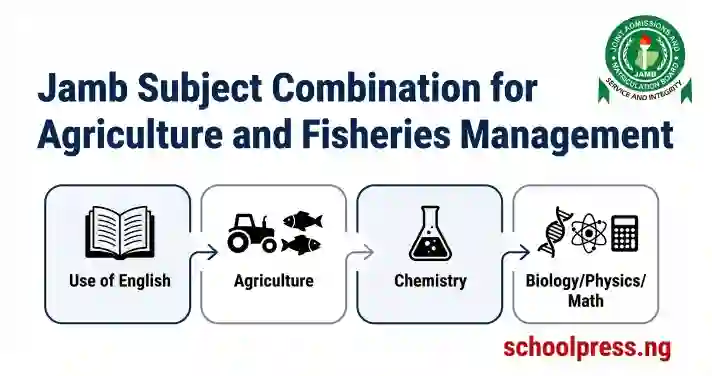
The Jamb subject combination for Agriculture and Fisheries Management determines your eligibility for admission into this vital agricultural program. Many prospective students lose admission opportunities because they register for wrong subject combinations or fail to meet specific university requirements.
This course prepares students for careers in sustainable fish farming, aquatic resource management, and agricultural development.
Understanding the admission requirements early helps you plan better and avoid costly mistakes. Whether you are a UTME candidate or considering Direct Entry, knowing what universities expect saves time and resources.
This guide covers O’level requirements, Jamb subject combinations, Direct Entry qualifications, universities offering the program, career prospects, and answers to common questions about Agriculture and Fisheries Management admissions.
Real Also: Jamb Subject Combination for all courses
O’Level Results Requirements for Agriculture and Fisheries Management
Your O’level results form the foundation of your admission application. Universities require specific subjects at credit level, and understanding these requirements helps you prepare adequately. Most institutions accept results from WAEC, NECO, or NABTEB, but some have preferences you should know.
The combination of your O’level results and UTME scores determines your competitiveness. Strong performance in core science subjects significantly improves your chances, especially for federal universities where competition is intense.
A. O’Level Requirements for Agriculture and Fisheries Management
Candidates must obtain five credit passes at not more than two sittings in SSCE, GCE, NECO, or equivalent examinations. The required subjects include English Language, Mathematics, Chemistry, Biology or Agricultural Science, and Physics or any other Science subject. Some universities accept Geography as an alternative to Physics.
English Language and Mathematics are compulsory for all candidates without exception. Chemistry and Biology are particularly important because they directly relate to the course content. Agricultural Science can substitute for Biology in most universities, giving candidates from agricultural backgrounds an advantage.
B. How to Combine Two Sitting Results Strategically
Universities allow you to combine results from two sittings, but you must do this wisely. Ensure your best grades appear in subjects that matter most: Chemistry, Biology, and Mathematics. Avoid repeating subjects where you already have credits unless you can score higher grades.
Plan your second sitting to address specific weaknesses in your first attempt. Focus intensive study efforts on the one or two subjects holding you back. Many candidates waste money repeating subjects they already passed instead of concentrating on actual problem areas.
C. Common O’Level Mistakes That Kill JAMB Efforts
Many students register for wrong subject combinations that exclude them from Agriculture and Fisheries Management programs. Writing Physics and Chemistry without Biology or Agricultural Science automatically disqualifies you from most universities. Always verify requirements from your target institutions before registrations.
Another common mistake involves using three sittings instead of two. Universities explicitly state “not more than two sittings,” and violating this rule leads to automatic disqualification regardless of your JAMB score. Some candidates also present results with different name spellings, creating verification problems during screening.
Jamb Subject Combination for Agriculture and Fisheries Management
The Jamb subject combination for Agriculture and Fisheries Management consists of three subjects you must register for during UTME. Choosing correctly ensures you can apply to your preferred universities. Wrong combinations eliminate you from consideration even if you score high marks.
Each university sets minimum cut-off marks based on competition and available spaces. Federal universities typically have higher requirements than state and private institutions. Understanding these thresholds helps you set realistic score targets.
A. UTME/Jamb Subjects Combination for Agriculture and Fisheries Management
The required UTME subjects are Chemistry, Biology or Agricultural Science, and Physics or Mathematics. Chemistry is compulsory for all candidates because it covers essential concepts for understanding aquatic environments and fish nutrition. Biology or Agricultural Science provides the biological foundation needed for fisheries management and aquaculture systems.
Physics helps students understand water dynamics and engineering aspects of fisheries. Mathematics is accepted as an alternative to Physics in most universities. Some institutions prefer candidates who take Biology over Agricultural Science, so check specific university requirements during registration.
B. minimum UTME/Jamb Score Requirements
Federal Universities require scores ranging from 180 to 200 depending on the institution and year. Universities like Federal University of Agriculture, Abeokuta, and Federal University of Technology, Minna, often set cut-offs around 180 to 190 for this course.
State Universities typically require scores between 160 and 180. Competition varies significantly based on location and university reputation. Rivers State University and Delta State University usually admit candidates within this range.
Private Universities maintain more flexible admission requirements, with scores ranging from 140 to 160. Institutions like Bowen University and Landmark University consider candidates with lower scores if other credentials are strong.
C. UTME/Jamb Subjects Special Consideration (Waiver) for Agriculture and Fisheries Management
Some universities grant subject waivers or special considerations for Agriculture and Fisheries Management. Federal University of Agriculture, Abeokuta accepts Mathematics in place of Physics for qualified candidates. University of Ilorin considers candidates who took Agricultural Science instead of Biology without penalty.
Rivers State University offers flexibility with Physics requirements if candidates have strong Chemistry and Biology scores. Ebonyi State University accepts Geography as an alternative science subject for candidates from riverine communities. Delta State University grants waivers for Physics when candidates demonstrate exceptional performance in Chemistry and Biology.
Direct Entry Requirements for Agriculture and Fisheries Management
Direct Entry provides an alternative admission pathway for candidates with advanced qualifications. This route allows students to enter at 200 level instead of starting from 100 level. It suits candidates with National Diploma, NCE, or A-level certificates in relevant fields.
Direct Entry candidates often complete their degree programs faster than UTME entrants. However, spaces are limited and requirements are stringent. Understanding who qualifies and what documents you need prevents application errors.
Candidates with ND in Fisheries, Agricultural Technology, or related fields should consider Direct Entry for Agriculture and Fisheries Management. Those with A-level passes in relevant science subjects also qualify. This pathway reduces time spent in university and can be more economical.
A. Direct Entry Requirements and Qualifications for Agriculture and Fisheries Management
Candidates must possess two A-level passes in Chemistry and Biology or Botany or Zoology from recognized institutions. National Diploma holders need Lower Credit or Merit passes in Fisheries, Agricultural Technology, Science Laboratory Technology, or related programs. NCE holders require Merit or Credit level passes in relevant science subjects.
Some universities accept IJMB or Cambridge A-level certificates with appropriate subject combinations. The certificates must come from institutions recognized by JAMB and the admitting university. Age is not typically a barrier, but candidates must meet all academic requirements.
B. O’level Direct Entry Requirements for Agriculture and Fisheries Management
Direct Entry candidates must still satisfy O’level requirements like UTME candidates. You need five credits including English Language, Mathematics, Chemistry, Biology or Agricultural Science, and Physics or another science subject. These credits must come from not more than two sittings.
Universities verify O’level results for all Direct Entry applicants during screening. Deficiencies in O’level requirements automatically disqualify candidates regardless of their advanced qualifications. Ensure all O’level subjects meet requirements before applying through Direct Entry.
C. Direct Entry Special Consideration (Waiver) for Agriculture and Fisheries Management
Federal University of Agriculture, Abeokuta accepts candidates with HND in Fisheries or Agricultural Engineering for Direct Entry admission. University of Ibadan considers candidates with strong ND results even with slight O’level deficiencies. Ahmadu Bello University grants waivers for candidates with extensive industry experience in aquaculture.
University of Port Harcourt accepts candidates from maritime academies with relevant certifications. Michael Okpara University of Agriculture offers Direct Entry to graduates of fisheries certificate programs. Lagos State University accepts mature candidates aged 25 and above with relevant work experience in fisheries.
Universities Offering Agriculture and Fisheries Management
Federal Universities: Federal University of Agriculture, Abeokuta. University of Ibadan. Ahmadu Bello University, Zaria. Federal University of Technology, Minna. University of Ilorin. Michael Okpara University of Agriculture, Umudike. Federal University, Dutse. University of Calabar. Federal University, Wukari. Modibbo Adama University of Technology, Yola.
State Universities: Rivers State University, Port Harcourt. Delta State University, Abraka. Lagos State University, Ojo. Ebonyi State University, Abakaliki. Akwa Ibom State University, Ikot Akpaden. Nasarawa State University, Keffi. Ibrahim Badamasi Babangida University, Lapai. Ekiti State University, Ado Ekiti.
Private Universities: Bowen University, Iwo. Landmark University, Omu-Aran. Caleb University, Lagos. Adeleke University, Ede. Madonna University, Okija. McPherson University, Seriki Sotayo.
Career Prospects in Agriculture and Fisheries Management
1. Aquaculture Farm Manager: Graduates oversee fish farming operations, managing breeding, feeding, health, and harvest processes. They develop business strategies for commercial fish farms and ensure profitability through efficient resource management. Positions exist in private farms, government hatcheries, and aquaculture corporations.
2. Fisheries Extension Officer: These professionals educate fishing communities about sustainable practices, new technologies, and resource conservation. They work for government agencies, NGOs, and development organizations. The role involves training fishermen, conducting workshops, and implementing community development programs.
3. Aquatic Resource Manager: Specialists monitor and protect water bodies, fish populations, and aquatic ecosystems. They work with environmental agencies, research institutes, and conservation organizations. Responsibilities include assessing fish stocks, enforcing regulations, and developing management plans for sustainable fisheries.
4. Fish Nutrition Specialist: Experts formulate feeds, optimize nutrition programs, and improve fish growth rates. They work for feed manufacturing companies, research institutions, and large-scale fish farms. This career combines knowledge of fish biology, nutrition science, and commercial production.
5. Fisheries Consultant: Independent consultants provide expert advice on farm design, business planning, disease management, and production optimization. They serve fish farmers, investors, government agencies, and international development organizations. Success requires extensive experience and strong business acumen.
6. Quality Control Officer: These officers ensure fish products meet safety and quality standards for domestic and export markets. They work for processing plants, regulatory agencies, and certification bodies. The role involves laboratory testing, inspection protocols, and compliance monitoring.
Frequently Asked Questions On Agriculture and Fisheries Management
1. Can I study Agriculture and Fisheries Management without Physics?
Yes, most universities accept Mathematics as a substitute for Physics in the JAMB subject combination. Some institutions also grant waivers if you have strong scores in Chemistry and Biology. However, you should verify specific requirements from your target universities before registration.
2. What is the difference between Fisheries and Agriculture and Fisheries Management?
Agriculture and Fisheries Management combines agricultural principles with fisheries science, covering both crop production and aquaculture. Pure Fisheries focuses exclusively on fish farming, aquatic resources, and marine biology. The combined program offers broader career options in both agricultural and fisheries sectors.
3. Can Agricultural Science replace Biology in O’level requirements?
Yes, virtually all universities accept Agricultural Science as an alternative to Biology for Agriculture and Fisheries Management. Both subjects provide the necessary biological foundation for the course. Candidates from agricultural secondary schools often have an advantage with Agricultural Science background.
4. Which university has the best Agriculture and Fisheries Management program?
Federal University of Agriculture, Abeokuta and University of Ibadan are highly regarded for their comprehensive programs and research facilities. Rivers State University and Delta State University excel due to their coastal locations and practical training opportunities. Choose based on your location, budget, and career goals.
5. What is the duration of Agriculture and Fisheries Management program?
The program typically runs for four years for UTME candidates and three years for Direct Entry students. Some universities require industrial attachments that may extend duration slightly. Part-time and sandwich programs may take five to six years depending on institutional policies.
6. Can I work in oil and gas companies with this degree?
Yes, graduates work in environmental departments of oil and gas companies conducting impact assessments, monitoring aquatic life, and managing environmental compliance. Companies operating in coastal areas regularly employ fisheries specialists. Additional certifications in environmental management enhance employment prospects.
7. Is JAMB cut-off mark the same as departmental screening score?
No, JAMB cut-off is the minimum score for eligibility, while departmental screening considers your aggregate score including O’level grades and post-UTME performance. A candidate with 180 JAMB score might not gain admission if their aggregate falls below the department’s threshold.
8. Can I apply for Agriculture and Fisheries Management with HND in Banking?
No, Direct Entry requirements mandate relevant qualifications in science, agriculture, or fisheries-related fields. HND in Banking does not meet these requirements. You would need to apply through UTME instead of Direct Entry for this course.
9. Do I need computer literacy for this course?
Modern fisheries management increasingly relies on data analysis, modeling software, and farm management systems. While not a formal admission requirement, computer skills significantly enhance your learning experience and career prospects. Many universities integrate computer applications into the curriculum.
10. Can I pursue postgraduate studies abroad with this degree?
Yes, graduates can pursue Masters and PhD programs in Aquaculture, Fisheries Science, Marine Biology, or related fields at universities worldwide. Ensure your institution has proper accreditation from relevant bodies. Strong academic performance and research experience improve admission chances to competitive international programs.
Source: Jamb Brochure