
2026 JAMB Subject Combination for Applied Biology
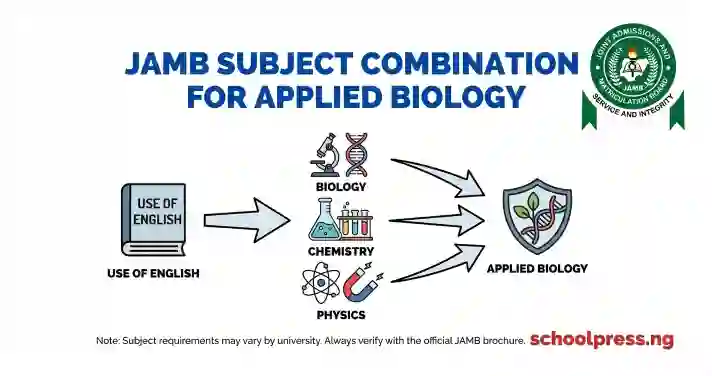
Applied Biology is a science program that prepares students for careers in biotechnology, environmental management, and research. Getting the right JAMB subject combination for Applied Biology is your first step toward admission success. Many students miss admission because they register wrong subjects or misunderstand entry requirements.
This happens more than you think. Students spend money on JAMB forms only to discover they can’t apply to their preferred institutions.
The requirements vary across universities. Some accept lower scores while others demand higher cut-off marks for the same course.
This guide covers everything you need: O’Level requirements, JAMB subject combinations, Direct Entry qualifications, universities offering Applied Biology, career prospects, and answers to common questions.
Real Also: Jamb Subject Combination for all courses
O’Level Results Requirements for Applied Biology
Your O’Level results determine if you qualify for admission consideration. Most universities require five credit passes in relevant subjects at not more than two sittings. The core science subjects must appear in your results.
A. O’Level Requirements for Applied Biology
You need five credit passes including English Language, Mathematics, Biology, Chemistry, and Physics. These subjects must be at credit level (C6 or better) in WAEC, NECO, or GCE. Some universities accept Agricultural Science in place of Biology, but this isn’t common. Always check your chosen institution’s specific requirements before applying.
B. How to Combine Two Sitting Results Strategically
Universities accept results from two different sittings. Your best strategy is getting the compulsory subjects (English and Mathematics) in your first sitting. Then focus on the remaining science subjects in your second attempt. Don’t repeat subjects you already passed unless you’re certain of better grades. This approach saves time and resources.
C. Common O’Level Mistakes That Kill JAMB Efforts
Many students register for JAMB before confirming they have the required O’Level subjects. Others use results older than five years, which some universities reject. Some candidates mix similar subjects like Biology and Agricultural Science, thinking both count. Another mistake is poor subject combination across two sittings. Always verify your results meet requirements.
JAMB Subject Combination for Applied Biology
Your UTME subject choice determines which courses you can apply for during the admission process. Wrong subject combinations automatically disqualify you from consideration regardless of your score. Universities use automated systems that filter out unqualified candidates based on subject combinations.
A. UTME/JAMB Subjects Combination for Applied Biology
The standard JAMB subjects for Applied Biology are Biology, Chemistry, and Physics. Some universities also accept Biology, Chemistry, and Mathematics as an alternative combination. The University of Ibadan and University of Lagos strictly require Biology, Chemistry, and Physics. Always confirm with your specific institution because requirements can differ even among federal universities.
B. Minimum UTME/JAMB Score Requirements
- Federal Universities: 180-200 (varies by institution and competition level)
- State Universities: 160-180 (depends on state policies and institutional standards)
- Private Universities: 140-180 (some accept lower scores with good O’Level results)
C. UTME/JAMB Subject Special Consideration (Waiver) for Applied Biology
Few universities offer waivers for Applied Biology. Federal University of Agriculture, Abeokuta accepts candidates who meet specific criteria. Obafemi Awolowo University considers exceptional candidates with strong O’Level backgrounds. University of Benin reviews waiver requests on a case basis. However, these waivers are rare and usually require additional qualifications or demonstrated excellence.
Direct Entry Requirements for Applied Biology
Direct Entry allows you to skip JAMB and enter 200 level directly. This route is for candidates with advanced qualifications beyond O’Level. It saves you one year of study and reduces the overall time to graduation.
Who qualifies? Candidates with NCE, ND, IJMB, Cambridge A’Level, or equivalent certificates in relevant science subjects. Your grades in these qualifications must meet minimum standards. Most universities require upper credit or merit level.
Who should consider Direct Entry for Applied Biology? If you have completed a science-based diploma or A’Level program, this route is ideal. Students with National Diploma in Science Laboratory Technology or related fields qualify. It’s also perfect for those who want to avoid UTME competition.
A. Direct Entry Requirements and Qualifications for Applied Biology
You need two A’Level passes in Chemistry and Biology or Zoology/Botany. For NCE or ND holders, minimum of upper credit in science subjects is required. IJMB candidates need five points including Chemistry and Biology. Cambridge A’Level requires passes at grades A-E. Your certificate must be from recognized institutions.
B. O’Level Direct Entry Requirements for Applied Biology
Five O’Level credit passes remain mandatory even for Direct Entry candidates. The subjects are English Language, Mathematics, Biology, Chemistry, and Physics. These must be obtained at one or two sittings. Direct Entry doesn’t exempt you from O’Level requirements. Both qualifications work together to determine your eligibility.
C. Direct Entry Special Consideration (Waiver) for Applied Biology
University of Ilorin accepts Direct Entry waivers for exceptionally qualified candidates. Federal University of Technology, Minna reviews applications with strong academic records. Ahmadu Bello University considers waivers for candidates with relevant work experience in biology fields. These are evaluated individually and aren’t guaranteed for every applicant.
Universities Offering Applied Biology
A. Federal Universities
- Federal University of Agriculture, Abeokuta
- University of Ibadan
- Obafemi Awolowo University, Ile-Ife
- University of Benin
- Federal University of Technology, Minna
- Ahmadu Bello University, Zaria
- University of Ilorin
- Federal University, Oye-Ekiti
- Federal University, Dutse
- University of Lagos
B. State Universities
- Lagos State University
- Ekiti State University
- Osun State University
- Rivers State University
- Kano State University of Science and Technology
- Nasarawa State University
- Kaduna State University
- Delta State University
C. Private Universities
- Covenant University
- Landmark University
- Bells University of Technology
- Bowen University
- Wesley University of Science and Technology
- Achievers University
D. Polytechnic Institutions
- Yaba College of Technology
- Federal Polytechnic, Ilaro
- Kaduna Polytechnic
- Federal Polytechnic, Ado-Ekiti
E. College of Education
- Federal College of Education, Zaria
- Adeniran Ogunsanya College of Education
Career Prospects in Applied Biology
1. Biotechnology Specialist: You work in labs developing new products from biological materials. Companies in pharmaceuticals, agriculture, and food processing hire biotechnology specialists. Your role involves research, product development, and quality control. Salaries range from ₦150,000 to ₦500,000 monthly depending on experience.
2. Environmental Consultant: You assess environmental impacts of projects and recommend solutions. Government agencies, construction companies, and NGOs need environmental consultants. Your work includes site surveys, report writing, and regulatory compliance. This field offers good pay and travel opportunities.
3. Research Scientist: Universities, research institutes, and private labs employ research scientists. You conduct experiments, publish findings, and contribute to scientific knowledge. Specializations include microbiology, genetics, ecology, or molecular biology. Advanced degrees improve your prospects significantly.
4. Quality Control Officer: Food companies, breweries, and pharmaceutical firms need quality control officers. You ensure products meet safety and quality standards. Laboratory testing, documentation, and compliance monitoring are your responsibilities. It’s stable employment with decent benefits.
5. Agricultural Officer: You help farmers improve crop yields using biological principles. Government agriculture departments and agribusiness companies hire agricultural officers. Your work involves field visits, farmer training, and implementing modern farming techniques. Rural postings are common but rewarding.
Frequently Asked Questions On Applied Biology
1. Can I study Applied Biology with C6 in Mathematics?
Yes, most universities accept C6 in Mathematics for Applied Biology. However, some competitive federal universities prefer B3 or better. Check your chosen institution’s specific requirements. State and private universities are generally more flexible with Mathematics grades.
2. Is Applied Biology the same as Biology Education?
No, they’re different programs. Applied Biology focuses on practical applications in industry, research, and biotechnology. Biology Education prepares you to teach Biology in secondary schools. Applied Biology graduates work in labs and companies while Biology Education graduates become teachers.
3. Can I become a medical doctor after studying Applied Biology?
Not directly. Applied Biology doesn’t lead to medical practice. However, you can pursue postgraduate studies in related medical fields like Public Health, Medical Microbiology, or Biotechnology. Some graduates also write JAMB again for Medicine if they meet the requirements.
4. Do I need Physics for Applied Biology in all universities?
Most universities require Physics as an O’Level subject. For JAMB, some accept Mathematics instead of Physics. University of Ibadan and a few others insist on Physics for both O’Level and UTME. Always verify with your specific institutions before registering.
5. What’s the difference between Applied Biology and Industrial Biology?
The programs are similar but Industrial Biology emphasizes manufacturing and production processes. Applied Biology has broader coverage including environmental science and research. Some universities use the names interchangeably. Check the course curriculum to understand what each institution offers.
6. Can I work in oil companies with Applied Biology?
Yes, oil companies hire Applied Biology graduates for environmental management roles. You’ll monitor pollution, conduct environmental impact assessments, and ensure regulatory compliance. However, competition is tough and additional certifications help your chances.
7. Is Applied Biology a lucrative course?
Career success depends on your specialization and skills. Biotechnology and pharmaceutical sectors offer good salaries. Environmental consulting pays well for experienced professionals. Research positions in universities start modest but improve with advanced degrees. Overall, it’s moderately lucrative with growth potential.
8. Can I use Agricultural Science instead of Biology for Applied Biology?
Very few universities accept Agricultural Science in place of Biology. Federal universities typically don’t allow this substitution. Some private and state universities might consider it. However, having Biology gives you more options and eliminates uncertainty.
9. What’s the duration of Applied Biology program?
Four years for UTME candidates entering 100 level. Direct Entry candidates spend three years starting from 200 level. Some students take five years due to carryovers or industrial training extensions. The program includes one year mandatory SIWES (industrial attachment).
10. Can I study Applied Biology and later switch to Medicine?
You can’t switch within the same university easily. You’ll need to write JAMB again and apply for Medicine as a fresh candidate. Your Applied Biology background gives you science knowledge but doesn’t guarantee Medicine admission. Meeting Medicine’s strict requirements is essential.
Source: Jamb Brochure