
2026 JAMB Subject Combination for Animal and Environmental Biology
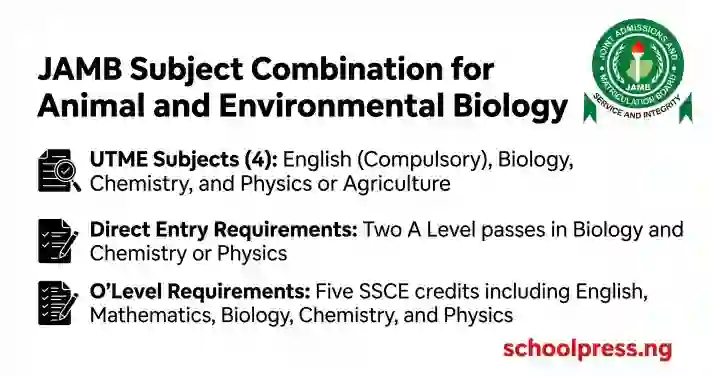
The JAMB subject combination for Animal and Environmental Biology determines your eligibility for admission into Nigerian universities. This biological science program trains students to understand animal life, ecosystems, and environmental conservation.
Many aspiring students miss admission because they choose wrong subject combinations or fail to meet O’Level requirements.
This guide provides complete information about UTME subject requirements, O’Level combinations, Direct Entry qualifications, accredited universities, and career opportunities.
You will learn the minimum JAMB scores for federal, state, and private universities. The article also explains waiver policies and common mistakes that affect admission chances.
Real Also: Jamb Subject Combination for all courses
O’Level Results Requirements for Animal and Environmental Biology
Your O’Level results form the foundation of your admission application. Universities require specific subjects with minimum credit passes. Most institutions accept results from WAEC, NECO, or NABTEB. You need five credit passes including English Language and Mathematics in not more than two sittings.
A. O’Level Requirements for Animal and Environmental Biology
You must obtain five credit passes at O’Level in the following subjects. English Language is compulsory for all applicants. Biology or Agricultural Science is essential for this course. Chemistry and Physics are required science subjects. Mathematics completes your core requirements. You can add any other science subject as your fifth credit.
Some universities accept Geography or Health Science as alternatives. Check your preferred institution’s specific requirements before registration. Most schools insist on Biology rather than Agricultural Science. The credit passes must be obtained in one or two sittings maximum.
B. How to Combine Two Sitting Results Strategically
You can combine results from two different examinations to meet requirements. Ensure you have Biology in your stronger result since it carries more weight. Place Chemistry and Physics in the sitting where you performed better. Avoid repeating subjects unless you failed them completely in the first attempt.
Universities prioritize candidates with one sitting results over those with two sittings. If you must use two results, ensure the combination gives you five distinct credits. Do not include the same subject twice even with different grades. Register for only subjects you failed or did not write initially.
C. Common O’Level Mistakes That Kill JAMB Efforts
Many students write irrelevant subjects that universities do not consider for admission. Writing General Mathematics instead of Mathematics can disqualify your application. Some candidates submit results with English Language below credit level. Omitting Biology or Chemistry eliminates you from consideration regardless of your JAMB score.
Waiting until after UTME to complete O’Level subjects creates unnecessary pressure. Some students combine results from three sittings which most universities reject. Using unapproved examination bodies like GCE automatically disqualifies your application. Always verify that your examination body is accredited by JAMB.
JAMB Subject Combination for Animal and Environmental Biology
Your UTME subject selection determines whether universities will consider your application. The examination body specifies three subjects alongside Use of English. Choosing wrong subjects means automatic disqualification even with high scores. Most biological science programs share similar subject requirements across institutions.
A. UTME/JAMB Subjects Combination for Animal and Environmental Biology
The standard JAMB subject combination includes Biology, Chemistry, and Physics. Biology examines your understanding of living organisms and life processes. Chemistry tests your knowledge of matter, reactions, and chemical properties. Physics assesses your grasp of natural phenomena and physical laws. Use of English is compulsory for all candidates regardless of course choice.
This combination applies to nearly all universities offering the program. Some institutions may accept Agricultural Science instead of Biology in rare cases. However, Biology remains the preferred and most widely accepted option. Ensure you register for exactly these subjects during UTME registration.
B. Minimum UTME/JAMB Score Requirements
1. Federal Universities: 180 to 200 (varies by institution)
Federal universities typically set cutoff marks between 180 and 200 points. Competitive schools like University of Nigeria Nsukka require 200 and above. Less competitive federal institutions may admit candidates with 180 points. Your departmental cutoff may differ from the general university cutoff mark.
2. State Universities: 160 to 180
State universities generally have lower cutoff marks ranging from 160 to 180. Some state schools accept 160 for less competitive courses. Popular state universities may require 180 for Animal and Environmental Biology. Check your chosen institution’s admission brochure for specific requirements.
3. Private Universities: 140 to 180
Private universities offer the most flexible admission requirements with cutoffs from 140. Some private institutions admit candidates with 140 JAMB score. Others maintain standards comparable to state universities at 180 points. Meeting the minimum score does not guarantee admission due to limited spaces.
C. UTME/JAMB Subjects Special Consideration (Waiver) for Animal and Environmental Biology
Very few universities offer subject waivers for this science-based program. The nature of the course requires strong foundation in Biology, Chemistry, and Physics. Most institutions strictly enforce the standard subject combination without exceptions. Students lacking any of these subjects must retake JAMB with correct combinations.
However, some universities may consider Agricultural Science instead of Biology on special request. University of Agriculture Makurdi occasionally grants this waiver for qualified applicants. Federal University of Technology Minna reviews such cases individually. Contact the admissions office directly to inquire about waiver possibilities before applying.
Direct Entry Requirements for Animal and Environmental Biology
Direct Entry allows candidates with advanced qualifications to enter 200 level directly. This admission route saves one year compared to the regular UTME admission process. JAMB issues Direct Entry forms to qualified applicants who meet specific criteria. You must possess relevant diplomas, NCE, or A-Level certificates in science subjects.
Candidates with at least lower credit in National Diploma qualify for consideration. Those holding NCE with merit or distinction in relevant subjects can apply. A-Level holders need two passes in science subjects related to the program. Your O’Level results must still meet the five credit requirements including English and Mathematics.
A. Direct Entry Requirements and Qualifications for Animal and Environmental Biology
You need National Diploma in Science Laboratory Technology or related fields with lower credit. NCE holders must have science subjects with minimum of merit grade. Cambridge A-Level requires passes in Biology and Chemistry or Physics. IJMB certificate holders need at least three relevant science subjects with good grades.
Ordinary National Diploma from accredited polytechnics qualifies you for Direct Entry consideration. Your diploma must be in Biological Sciences, Microbiology, or closely related programs. Some universities accept Higher National Diploma but admit candidates into 200 level. Ensure your institution and program are accredited by relevant regulatory bodies.
B. O’Level Direct Entry Requirements for Animal and Environmental Biology
Direct Entry candidates must meet the same O’Level requirements as UTME applicants. You need five credit passes including English Language, Mathematics, Biology, Chemistry, and Physics. The credits must be obtained in one or two sittings maximum. Your O’Level results should complement your advanced qualifications for admission.
Universities verify O’Level results before processing Direct Entry applications regardless of other certificates. Deficiency in O’Level automatically disqualifies you even with excellent diploma grades. Ensure all your credits are from approved examination bodies. Some institutions may request higher O’Level grades for Direct Entry candidates.
C. Direct Entry Special Consideration (Waiver) for Animal and Environmental Biology
Direct Entry waivers are extremely rare for this program due to its technical nature. Federal University of Agriculture Abeokuta occasionally considers exceptional candidates with related qualifications.
University of Benin reviews applications from candidates with strong research backgrounds individually. Ahmadu Bello University Zaria may grant waivers to diploma holders with distinctions.
You must provide compelling academic records to qualify for any waiver consideration. Contact the department directly with your credentials before applying through Direct Entry.
Most universities maintain strict requirements without exceptions for this science program. Focus on meeting standard requirements rather than expecting special considerations.
Universities Offering Animal and Environmental Biology
Many Nigerian universities offer Animal and Environmental Biology as an undergraduate program. The National Universities Commission accredits institutions to ensure quality education standards.
Federal universities dominate the list with well-established biological science departments. State and private universities also provide quality training in this field.
A. Federal Universities
- Abubakar Tafawa Balewa University, Bauchi
- Ahmadu Bello University, Zaria
- Bayero University, Kano
- Federal University of Agriculture, Abeokuta
- Federal University of Technology, Akure
- Federal University of Technology, Minna
- Federal University of Technology, Owerri
- Michael Okpara University of Agriculture, Umudike
- Modibbo Adama University of Technology, Yola
- University of Abuja
- University of Agriculture, Makurdi
- University of Benin
- University of Calabar
- University of Ibadan
- University of Ilorin
- University of Jos
- University of Lagos
- University of Maiduguri
- University of Nigeria, Nsukka
- University of Port Harcourt
- University of Uyo
- Usmanu Danfodiyo University, Sokoto
B. State Universities
- Abia State University, Uturu
- Adamawa State University, Mubi
- Adekunle Ajasin University, Akungba
- Ambrose Alli University, Ekpoma
- Bauchi State University, Gadau
- Delta State University, Abraka
- Ebonyi State University, Abakaliki
- Ekiti State University, Ado Ekiti
- Enugu State University of Science and Technology
- Ibrahim Badamasi Babangida University, Lapai
- Kaduna State University
- Kano University of Science and Technology, Wudil
- Kogi State University, Anyigba
- Lagos State University
- Nasarawa State University, Keffi
- Niger Delta University, Wilberforce Island
- Olabisi Onabanjo University, Ago Iwoye
- Rivers State University
- Taraba State University, Jalingo
- Yobe State University, Damaturu
C. Private Universities
- Achievers University, Owo
- Ajayi Crowther University, Oyo
- Bells University of Technology, Ota
- Bowen University, Iwo
- Covenant University, Ota
- Crawford University, Igbesa
- Godfrey Okoye University, Enugu
- Igbinedion University, Okada
- Landmark University, Omu Aran
- Lead City University, Ibadan
- Madonna University, Okija
- Redeemer’s University, Ede
- Salem University, Lokoja
- Wesley University of Science and Technology, Ondo
D. Polytechnic Institutions
- Federal Polytechnic, Ado Ekiti
- Federal Polytechnic, Bida
- Federal Polytechnic, Idah
- Federal Polytechnic, Nekede
- Kaduna Polytechnic
- Lagos State Polytechnic
- Yaba College of Technology, Lagos
Career Prospects in Animal and Environmental Biology
Graduates of Animal and Environmental Biology enjoy diverse career opportunities across multiple sectors. The program equips you with skills in research, conservation, and environmental management.
Government agencies, research institutes, and private organizations actively recruit Animal and Environmental Biology graduates. Your knowledge of ecosystems and animal life opens doors to specialized positions.
1. Wildlife Conservation Officer: You will manage protected areas and coordinate conservation programs for endangered species. Government wildlife departments and conservation NGOs employ officers to monitor animal populations. Your role includes habitat assessment, anti-poaching activities, and community education programs.
2. Environmental Consultant: You can advise organizations on environmental impact assessments and sustainability practices. Private firms hire consultants to ensure compliance with environmental regulations. Your expertise helps companies minimize ecological damage while maintaining operational efficiency.
3. Research Scientist: You will conduct studies on animal behavior, ecology, and environmental processes in research institutions. Universities, government agencies, and private research centers need scientists for ongoing projects. Your work contributes to scientific knowledge and informs conservation policies.
4. Ecotourism Manager: You can develop and manage nature-based tourism ventures that promote conservation. National parks and private reserves employ managers to oversee visitor programs. Your role balances economic benefits with environmental protection and wildlife welfare.
5. Laboratory Technologist: You will perform biological tests and analyses in medical, agricultural, or environmental laboratories. Hospitals, research centers, and quality control departments need skilled technologists. Your training enables you to handle specimens and operate specialized equipment.
6. Environmental Health Officer: You can monitor and enforce environmental health standards in communities and industries. State and local governments employ officers to inspect facilities and investigate complaints. Your work protects public health by ensuring proper waste management and pollution control.
7. Agricultural Extension Officer: You will educate farmers on sustainable practices that protect biodiversity and soil health. Agricultural development programs need officers to bridge research and farming communities. Your expertise helps improve food production while conserving natural resources.
Frequently Asked Questions On Animal and Environmental Biology
1. Can I study Animal and Environmental Biology without Physics in JAMB?
No, Physics is a compulsory UTME subject for Animal and Environmental Biology in virtually all Nigerian universities. The program requires strong foundation in all three core sciences. You must register for Biology, Chemistry, and Physics alongside Use of English. Attempting to gain admission without Physics will result in disqualification regardless of your other qualifications.
2. What is the difference between Animal and Environmental Biology and Zoology?
Animal and Environmental Biology focuses on the relationship between animals and their environment including conservation. Zoology concentrates specifically on animal structure, physiology, and classification without extensive environmental emphasis. Both programs share similar admission requirements and career prospects. Your choice depends on whether you prefer broader environmental context or specialized animal studies.
3. Can I use Agricultural Science instead of Biology for JAMB?
Most universities strictly require Biology rather than Agricultural Science for this program. Only a few institutions like University of Agriculture Makurdi may consider Agricultural Science on special request. Biology remains the preferred subject because it directly relates to the course content. Contact your preferred university’s admissions office to confirm their specific policy before registration.
4. Do private universities require lower JAMB scores than federal universities?
Yes, private universities generally set lower cutoff marks ranging from 140 to 180 points. Federal universities typically require 180 to 200 for Animal and Environmental Biology. However, lower cutoff does not mean inferior education quality at accredited private institutions. Consider factors like accreditation, facilities, and faculty quality beyond just admission requirements.
5. Can I gain admission with two sitting results?
Yes, most universities accept two sitting results provided you obtain five credits including required subjects. You must combine the results strategically to show five distinct credit passes. One sitting candidates receive priority during admission selection when spaces are limited. Ensure your combination includes English, Mathematics, Biology, Chemistry, and Physics from approved examinations.
6. What NCE subjects qualify me for Direct Entry admission?
You need NCE in science subjects related to Biology such as Biology/Chemistry or Biology/Physics combinations. Your NCE results must show at least merit grade in relevant subjects. Some universities also accept Integrated Science with Biology specialization for Direct Entry consideration. Verify your NCE program’s relevance with your target university before applying.
7. How long does the Animal and Environmental Biology program take?
The program runs for four years through UTME admission leading to a Bachelor of Science degree. Direct Entry candidates spend three years starting from 200 level. Some universities with industrial attachment programs may require an additional semester. Part-time and sandwich programs where available may take longer than regular full-time study.
8. Can I work in hospitals with Animal and Environmental Biology degree?
Yes, you can work in hospital laboratories as a biological scientist or medical laboratory scientist. Many graduates find employment in pathology departments conducting diagnostic tests. However, you may need additional certifications from professional bodies like Medical Laboratory Science Council. Your degree provides the foundation for various laboratory-based healthcare positions.
9. Which universities offer the best Animal and Environmental Biology programs?
University of Ibadan, University of Nigeria Nsukka, and University of Lagos have well-established programs with excellent facilities. Ahmadu Bello University and Federal University of Agriculture Abeokuta also offer quality training. Consider factors like accreditation status, research output, and graduate employment rates. Visit campuses and speak with current students before making your final choice.
10. Do I need to take any professional examinations after graduation?
Professional certification depends on your chosen career path after graduation. Environmental consultants may need registration with Environmental Health Officers Council. Those pursuing medical laboratory work must register with Medical Laboratory Science Council. Wildlife conservation positions may require specific training from Nigerian Conservation Foundation. Research careers typically require postgraduate degrees rather than professional certifications.
Source: Jamb Brochure