
2026 Jamb Subject Combination for Animal Production
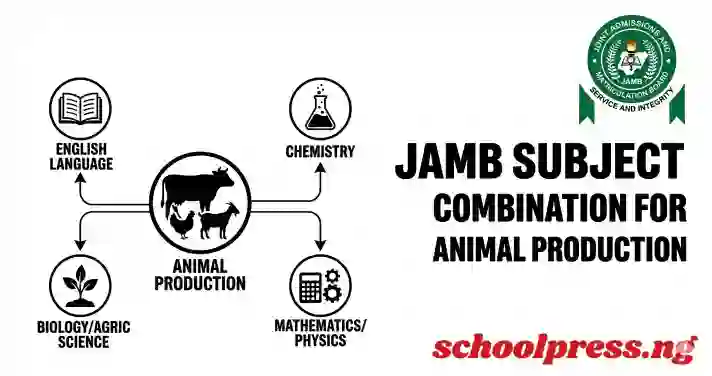
The Jamb subject combination for Animal Production determines your eligibility for this agricultural science program in Nigerian universities.
Animal Production focuses on livestock management, breeding, nutrition, and the scientific principles behind productive animal husbandry. This field trains students to become experts in raising cattle, poultry, fish, and other domestic animals for food and economic purposes.
Getting your subject combination right saves you from admission disappointments. Many students lose admission opportunities because they chose wrong subjects or failed to meet O’level requirements. This guide covers everything you need to know about entering Animal Production programs.
You will learn the correct UTME subjects, O’level requirements, direct entry qualifications, universities offering the course, and career opportunities available after graduation. We also address common questions students ask about Animal Production admissions.
NOTE: This subject combination requirement also suitable for the following courses; Animal Production with Nutrition, Animal Production & Health Service
Real Also: Jamb Subject Combination for all courses
O’Level Results Requirements for Animal Production
Your O’level results form the foundation of your JAMB application. Universities examine these results carefully before considering your UTME score. Most institutions require five credit passes in relevant subjects at not more than two sittings.
A. O’Level Requirements for Animal Production
You need five credit passes including English Language, Mathematics, and three science subjects. The science subjects must include Biology or Agricultural Science, Chemistry, and Physics. Some universities accept a combination of Biology, Chemistry, and Agricultural Science instead of Physics.
English Language and Mathematics are compulsory for all science programs. You cannot substitute them with any other subject. Biology provides essential knowledge about animal anatomy and physiology. Chemistry helps you understand animal nutrition and drug composition. Physics covers environmental factors affecting livestock production.
Agricultural Science offers practical knowledge about farming systems. Some universities prefer candidates with Agricultural Science background. Check your target university’s specific requirements before making O’level subject choices. Federal universities typically maintain stricter requirements than state or private institutions.
B. How to Combine Two Sitting Results Strategically
JAMB allows you to combine results from two O’level examinations. You can use WAEC, NECO, NABTEB, or GCE in any combination. The key is ensuring all five required subjects appear with credit grades across both results.
Use your stronger result as the primary certificate. If you scored A in Biology in your first sitting, do not retake it. Focus on improving weaker subjects in your second attempt. This strategy saves time and reduces examination costs.
Avoid having the same subject appear twice with different grades. This creates confusion during screening and may lead to disqualification. Plan your second sitting carefully to complement your first result. Universities verify all certificates, so ensure both results are authentic.
C. Common O’Level Mistakes That Kill JAMB Efforts
Many students register for wrong subject combinations in O’level examinations. They assume any science subjects will work for Animal Production. This assumption costs them admission opportunities. Always verify requirements before registering for O’level exams.
Another mistake is failing English Language or Mathematics repeatedly. Some students focus on science subjects and neglect these core subjects. No university admits candidates without credit passes in English and Mathematics regardless of their science grades.
Using unaccredited examination bodies creates problems. Stick to WAEC, NECO, NABTEB, or GCE. Some private examination bodies lack JAMB recognition. Students who use such results face automatic disqualification during screening.
Jamb Subject Combination for Animal Production
Your UTME subject choice must align with O’level subjects and university requirements. The right combination gives you access to multiple universities. Wrong choices limit your options significantly.
A. UTME/Jamb Subjects Combination for Animal Production
The standard UTME subjects for Animal Production are Biology, Chemistry, and Physics or Mathematics. Biology is compulsory because Animal Production is a biological science. You cannot substitute Biology with any other subject.
Chemistry appears in all science-based agriculture programs. It covers animal nutrition, biochemistry, and drug administration. Physics helps you understand housing systems, equipment design, and environmental control in animal production.
Some universities accept Mathematics instead of Physics. Mathematics is useful for statistical analysis in breeding programs and farm economics. Check your chosen universities to see which combination they prefer. Federal universities generally require Physics while state universities offer more flexibility.
B. Minimum UTME/Jamb Score Requirements
1. Federal Universities: Federal institutions typically require between 180 and 220 points for Animal Production. Top universities like the University of Ibadan or Ahmadu Bello University may demand scores above 200. Competition varies by year and number of applicants.
2. State Universities: State universities usually set cut-off marks between 160 and 200 points. These institutions offer more admission spaces and face less competition. Your chances improve significantly with scores above 180 points.
3. Private Universities: Private universities maintain flexible admission standards. Most accept candidates with 140 to 180 points. They focus more on O’level results and conduct internal screening tests. Private institutions process admissions faster than public universities.
C. UTME/Jamb Subjects Special Consideration (Waiver) for Animal Production
Some universities grant waivers for specific UTME subjects. These waivers allow you to substitute one science subject with another approved option. However, Biology remains compulsory across all institutions offering Animal Production.
Federal University of Agriculture, Abeokuta accepts Agricultural Science instead of Physics for candidates with strong backgrounds in practical farming. University of Ilorin considers Mathematics as an alternative to Physics for Animal Production applicants.
Obafemi Awolowo University offers subject waivers for candidates with A’level certificates in relevant subjects. Michael Okpara University of Agriculture, Umudike accepts Chemistry, Biology, and Agricultural Science combination. Always confirm current waiver policies directly with your target university.
Direct Entry Requirements for Animal Production
Direct Entry provides an alternative admission pathway for qualified candidates. This option allows you to enter the program at 200 level, skipping the first year. Direct Entry suits candidates with advanced qualifications beyond O’level certificates.
Who qualifies for Direct Entry? Candidates with National Diploma, NCE, Cambridge A’level, IJMB, or equivalent certificates qualify. Your certificate must be in a science-based field related to agriculture or biological sciences. Professional certificates in animal health or livestock management also qualify.
Who should consider Direct Entry for Animal Production? If you completed ND in Animal Health Technology, Agricultural Technology, or Science Laboratory Technology, Direct Entry saves you one academic year. NCE holders in Agricultural Science or Biology also benefit from this pathway. A’level students with relevant subjects gain direct admission advantages.
A. Direct Entry Requirements and Qualifications for Animal Production
Universities require two A’level passes or equivalent in relevant subjects. These subjects typically include Biology, Chemistry, Physics, or Agricultural Science. Your A’level grades must be at least grade C or above for competitive universities.
National Diploma holders need Lower Credit or above in Animal Health, Agricultural Technology, or related fields. The diploma must come from accredited polytechnics recognized by NBTE. Universities conduct additional screening for diploma holders.
NCE holders require Merit or above in Agricultural Science, Biology, or Integrated Science. The NCE certificate must come from recognized colleges of education. IJMB candidates need at least three relevant subjects with good grades.
B. O’level Direct Entry Requirements for Animal Production
Direct Entry candidates must still meet O’level requirements. You need five credit passes including English Language and Mathematics. The same science subjects required for UTME apply here as well.
Your O’level results can come from one or two sittings. Universities do not reduce O’level standards for Direct Entry applicants. In fact, some institutions demand stronger O’level results for Direct Entry than regular UTME admission.
Ensure your O’level subjects align with your advanced certificate subjects. If your diploma focused on Animal Health, your O’level should reflect science background. Consistency across certificates strengthens your application during screening.
C. Direct Entry Special Consideration (Waiver) for Animal Production
Federal University of Agriculture, Abeokuta offers Direct Entry waivers for candidates with HND in Animal Production or related fields. University of Nigeria, Nsukka accepts NCE in Agricultural Science with distinction grades at 200 level entry.
Ahmadu Bello University provides waivers for Cambridge A’level holders with any three science subjects. Obafemi Awolowo University considers professional certificates from recognized livestock institutes for mature applicants.
University of Ibadan grants special consideration to candidates with research publications in animal science journals. These waivers require submission of additional documentation during the application process.
Universities Offering Animal Production
Animal Production programs exist across federal, state, and private universities in Nigeria. Each institution brings unique strengths in research facilities, practical training, and industry partnerships.
1. Federal Universities
Ahmadu Bello University: One of the pioneers in Animal Production education with extensive livestock research facilities.
Federal University of Agriculture, Abeokuta: Specializes in agricultural sciences with modern animal farms and breeding centers.
University of Ibadan: Offers comprehensive Animal Production programs with strong veterinary collaboration.
University of Nigeria, Nsukka: Features advanced research in tropical animal production systems.
Michael Okpara University of Agriculture, Umudike: Focuses on practical livestock management and sustainable production.
Federal University of Technology, Minna: Combines engineering applications with animal production technology.
University of Ilorin: Provides balanced theoretical and practical training in livestock sciences.
Modibbo Adama University of Technology, Yola: Emphasizes animal production in semi-arid environments.
2. State Universities
Lagos State University: Offers Animal Production within its agricultural science programs.
Rivers State University: Provides training focused on aquaculture and livestock integration.
Ebonyi State University: Features programs emphasizing small-scale animal production systems.
Kogi State University: Combines animal science with rural development initiatives.
Nasarawa State University, Keffi: Focuses on sustainable livestock production practices.
3. Private Universities
Bowen University: Operates functional teaching and research farms for Animal Production students.
Covenant University: Integrates modern technology with traditional animal production methods.
Landmark University: Features mechanized farming systems and animal production research centers.
Joseph Ayo Babalola University: Provides practical training in poultry and cattle production.
Crawford University: Offers specialized training in commercial livestock management.
Career Prospects in Animal Production
Animal Production graduates enjoy diverse career opportunities across government, private sector, and entrepreneurship. The growing demand for animal protein in Nigeria creates numerous job openings for qualified professionals.
1. Livestock Farm Manager: You oversee daily operations of commercial farms raising cattle, poultry, pigs, or fish. This role involves managing workers, monitoring animal health, controlling feed costs, and ensuring optimal production. Salaries range from 150,000 to 500,000 monthly depending on farm size.
2. Animal Nutritionist: You formulate balanced feeds that maximize animal growth and production efficiency. This career requires understanding nutrient requirements for different species and production stages. Feed mills, farms, and research institutes employ nutritionists with starting salaries around 120,000 monthly.
3. Breeding Specialist: You design and implement breeding programs to improve livestock genetics. This involves selecting superior animals, managing reproduction, and keeping detailed breeding records. Government breeding stations and private livestock companies need these experts with salaries between 150,000 and 400,000 monthly.
4. Extension Officer: You educate rural farmers on modern livestock production techniques. Working with agricultural development programs, you demonstrate best practices, distribute inputs, and organize training sessions. Government agencies and NGOs employ extension officers with monthly earnings around 100,000 to 250,000.
5. Quality Control Officer: You ensure livestock products meet safety and quality standards in processing plants. This role involves laboratory testing, sanitation monitoring, and compliance with regulations. Food processing companies and export firms hire these professionals with salaries starting at 130,000 monthly.
6. Livestock Production Consultant: You provide expert advice to farmers and agribusinesses on production challenges. Running your consulting firm, you earn based on project contracts and advisory fees. Experienced consultants charge between 50,000 and 200,000 per assignment.
7. Research Officer: You conduct studies to improve livestock production systems through government or university research institutes. This career involves designing experiments, analyzing data, and publishing findings. Research positions offer salaries between 120,000 and 350,000 monthly with additional research grants.
Frequently Asked Questions On Animal Production
1. Can I study Animal Production without Physics in my O’level?
Yes, some universities accept Agricultural Science instead of Physics. However, you must have Biology and Chemistry as mandatory science subjects. Check specific university requirements before making assumptions. Private universities tend to be more flexible with Physics requirements than federal institutions.
2. What is the difference between Animal Production and Animal Science?
The programs are essentially similar with slight curriculum variations. Animal Production emphasizes practical livestock management and production economics. Animal Science includes more research and biological sciences. Some universities use the names interchangeably. Both lead to similar career opportunities.
3. Do I need farming experience before studying Animal Production?
No prior farming experience is required for admission. Universities provide practical training during the program. However, having farming background helps you understand concepts faster. Many successful Animal Production students come from urban areas without any farming exposure.
4. Can Animal Production graduates work in veterinary clinics?
Animal Production graduates cannot practice as veterinarians. Veterinary medicine requires a separate degree program. However, you can work in animal health product companies, feed mills, or as farm health managers. Some graduates pursue postgraduate studies in veterinary fields.
5. Is Animal Production a lucrative career in Nigeria?
Yes, Animal Production offers good earning potential especially with entrepreneurship. Nigeria’s protein deficit creates strong demand for livestock products. Starting salaries may seem modest, but experienced professionals and farm owners earn substantially. Success depends on your skills and business acumen.
6. Can I combine WAEC and NECO results for Animal Production admission?
Yes, JAMB allows combining results from two different examination bodies. Ensure you have all five required subjects with credit grades across both results. The combination must include English Language, Mathematics, Biology, Chemistry, and Physics or Agricultural Science.
7. Which university offers the best Animal Production program in Nigeria?
Ahmadu Bello University, Federal University of Agriculture Abeokuta, and University of Ibadan rank highly for Animal Production. These institutions have excellent research facilities and experienced faculty. However, the best university depends on your location, finances, and specific interests within Animal Production.
8. Can I study Animal Production and become a farm owner?
Absolutely, many Animal Production graduates establish successful livestock farms. The program equips you with technical knowledge and management skills for running profitable farms. Starting requires capital, but you can begin small and expand gradually using your training.
9. What postgraduate options exist after Animal Production?
You can pursue Master’s degrees in Animal Nutrition, Animal Breeding, Animal Physiology, or Agricultural Economics. Professional certifications in livestock management and farm business management enhance career prospects. Some graduates study Veterinary Medicine or Agricultural Extension at postgraduate level.
10. Does Animal Production include fish farming?
Most Animal Production programs cover aquaculture or fish farming basics. Some universities offer specialized courses in fisheries and aquaculture within their Animal Production curriculum. If fish farming particularly interests you, check whether your target university includes substantial aquaculture content in their program.
Source: Jamb Brochure